
Broward County Court Records After a Jail Arrest
After someone is arrested and booked in Broward County, the case does not become a court record right away. The Broward State Attorney for the 17th Judicial Circuit reviews the arrest using police reports, witness statements, and evidence. The prosecutor then files formal charges, declines them, changes them, or sends the case to a grand jury. That filing opens the court case, and from there the records track the charges, hearings, and disposition. Current State Attorney Harold F. Pryor leads the office that makes those filing decisions.
It helps to keep the booking side and the court side apart. The booking record, custody status, and current location live on the jail roster, covered on the jail inmate records page, and the booking photo appears on the jail mugshots page. The court record is the separate file the clerk keeps once charges are filed after the arrest. The two can differ, because the prosecutor may not file the same charges the officer listed at booking.
How to Find Broward County Court Records After an Arrest
Filed charges and their status show up in the Broward Clerk of Courts public case search, not on the jail roster. The clerk's portal lets you search by party name, business name, case number, or citation. Online data is not the clerk's official record, and results are capped at the first 200, so a narrow search works best.
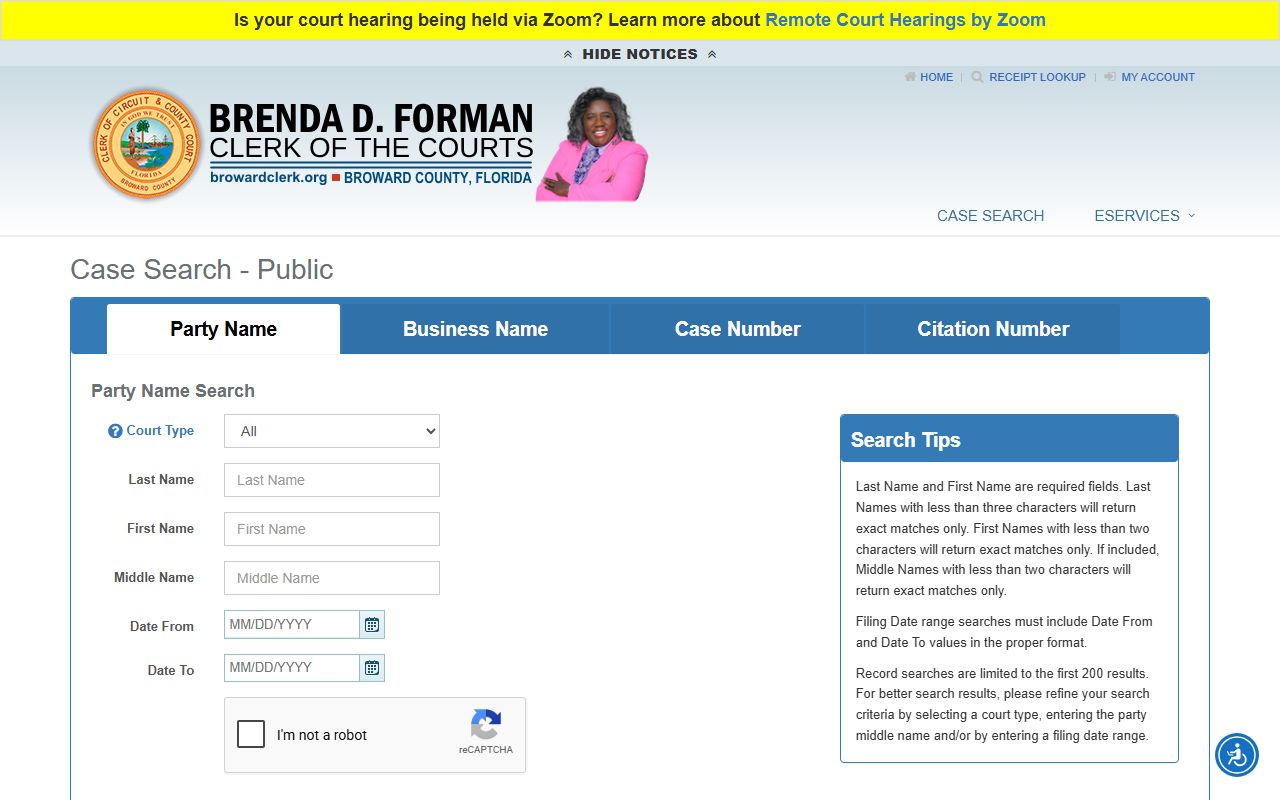
The clerk's case search, shown above, is the main public route to a Broward court record after an arrest. The steps below walk through a name search.
- Open the Broward Clerk case search.
- Search by defendant last and first name, or by case number if you have it.
- Open the case and read the list of filed charges.
- Check each charge's statute, level, and current status.
For a statewide criminal-history check rather than a single county case, the Florida Department of Law Enforcement is the right office, and a Broward arrest-only records check goes through the sheriff's public-records unit. The clerk's case search is the place to find the court record itself after an arrest.
How Charges Get Filed After an Arrest: Complaint, Information, and Indictment
Walk it forward from the arrest. Booking happens at the jail, then the court charge record begins when the prosecutor files a charging document. In Florida, most felonies are charged by an information filed by the State Attorney, while the most serious cases can go to a grand jury for an indictment. A complaint or the initial charge can start a misdemeanor case. Each path opens a court file.
| Complaint | Information | Indictment | |
|---|---|---|---|
| Filed By | Officer / Prosecutor | State Attorney | Grand Jury |
| Common For | Misdemeanors | Many felonies | Serious felonies |
| Starts | The case | The case | The case |
Charge Status in Court Records After an Arrest
Charges move as a case develops. The prosecutor can amend, reduce, add, or drop a charge, and a judge can dismiss one. This is why the booking charges on the jail roster can differ from the charges the State Attorney finally files. The clerk's record shows the current status, and the terms below come up often.
| Status | What It Means |
|---|---|
| Pending | The charge is filed and the case is still open. |
| Amended / Reduced | The prosecutor changed the charge, often to a lesser offense. |
| Dismissed | A judge ended the charge so it no longer proceeds. |
| Nolle Prosequi | The prosecutor chose not to pursue the charge. |
The clerk's case file can also link to parties, charges, warrants, bonds, arrests, hearings, and dispositions, though the clerk notes not every document is online and some access is restricted.
Bond and Release After an Arrest
Bond is usually addressed at first appearance, the early hearing where a judge reviews conditions. In Broward, charge and bond information is available through the sheriff's arrest search, by phone at (954) 982-6924 or (954) 982-6925, or at the Main Jail lobby information window, open 24 hours. Posting bond does not always mean release, because a separate hold or detainer can keep a person in custody.
| Bond Type | How It Works |
|---|---|
| Cash Bond | Paid in cash at the cash-bond window with valid ID; no service fee for cash. |
| Surety Bond | Posted through a licensed bail agent, who charges a percentage as a fee. |
| PR / Own Recognizance | Release on a written promise to appear, without full cash bond. |
| No-Bond Hold | Custody status where bond is not available or not yet set. |
Card payments can be made online with a 2.5 percent non-refundable fee, and the Cash Bond Unit answers at (954) 831-5932. Cash bonds are refundable after the case ends, though the clerk can withhold money for unpaid court fees under Florida law.
Warrants That Lead to an Arrest
A warrant can exist in a court case before anyone is in custody. The Broward Sheriff's Office routes warrant searches to the Broward Clerk, since there is no single public countywide active-warrant list. The clerk's case search shows case-linked warrant and capias activity, and the FDLE Wanted Persons search is the statewide supplemental channel. Once a warrant is served and the person is booked, the arrest appears in the sheriff's arrest search.
A bench warrant or capias is often issued for a failure to appear. Do not treat a website check as legal advice. A warrant can result in arrest, so the safe path is to verify case status with the clerk and speak with an attorney about next steps.
Charges vs. Convictions
Being arrested and charged is not the same as being convicted. A charge is an accusation that must be proven; a conviction is the result of a plea or a verdict. The sheriff's own disclaimer states that an arrest does not mean a conviction.
| Charge | Conviction | |
|---|---|---|
| Stage | Accusation | Verdict or plea |
| Burden of Proof | Probable cause | Beyond a reasonable doubt |
| Public Record | Yes | Yes |
Sealed vs. Expunged Arrest Records
Florida law lets an eligible person clear a record after a dismissal or a qualifying outcome. Sealing hides the record from public view; expunction goes further and treats it as destroyed. Sealing is governed by Florida Statutes section 943.059, and expunction by section 943.0585. Eligibility is specific, and the State Attorney's Seal and Expunge unit handles part of the process.
| Sealed | Expunged | |
|---|---|---|
| Visibility | Hidden from public view | Destroyed or treated as never existing |
| Law Enforcement | Limited access | Very limited access |
| Florida Statute | § 943.059 | § 943.0585 |
Note: Sealing or expunging a court record does not by itself force a sheriff to pull a booking photo, so handle the roster and the court record as separate steps.
Background Check Considerations
A casual court-records lookup is not the same as a regulated background check. Formal screening for jobs, housing, or credit must follow the Fair Credit Reporting Act and use a licensed consumer reporting agency. Court records found in a public case search are not a substitute for that process.
Important: This site is not a consumer reporting agency under the FCRA, and its information may not be used for employment, tenant, credit, or insurance decisions.
Public Records and Official Court Copies
It helps to keep three sets of records apart. The sheriff holds arrest, booking, and incident records, requested through its public-records unit. The Broward Clerk holds the court file, including the docket, filed charges, hearings, and dispositions. The State Attorney holds prosecution files and program information. Treating these as one database is a common mistake, because each office answers a different question.
The clerk's online case search is not the clerk's official record, and some documents are restricted from public view. For a certified copy, the clerk's office is the source, with traffic and misdemeanor copies and felony copies handled at the Broward County Judicial Complex. For State Attorney public records, the office lists a public-records contact, Misty Williams, reachable at (954) 831-7228 and through the office's records email.
Victim Notifications After an Arrest
People following a case for safety reasons can register for custody alerts rather than checking a roster by hand. Florida VINE, reachable through VINELink, provides release, transfer, escape, and out-to-court notifications where the holding agency supplies data. The Florida Department of Corrections also offers a victim-notification form for state custody. VINE supplements the court record and the jail roster; it does not replace either one. The State Attorney's office runs victim and witness units that connect people to these services during a case.
Restricted Court Records After an Arrest in Broward County
Florida starts from open records, but exemptions apply. Juvenile cases, sealed or expunged charges, active-investigation material, and protected-person information can be withheld or redacted. Florida Statutes section 119.071 lists general exemptions, and the clerk's online search may omit restricted documents even when the case metadata shows. When a record is limited, the route is a direct request to the clerk or the agency that holds it, and certified copies may require a fee.